Lab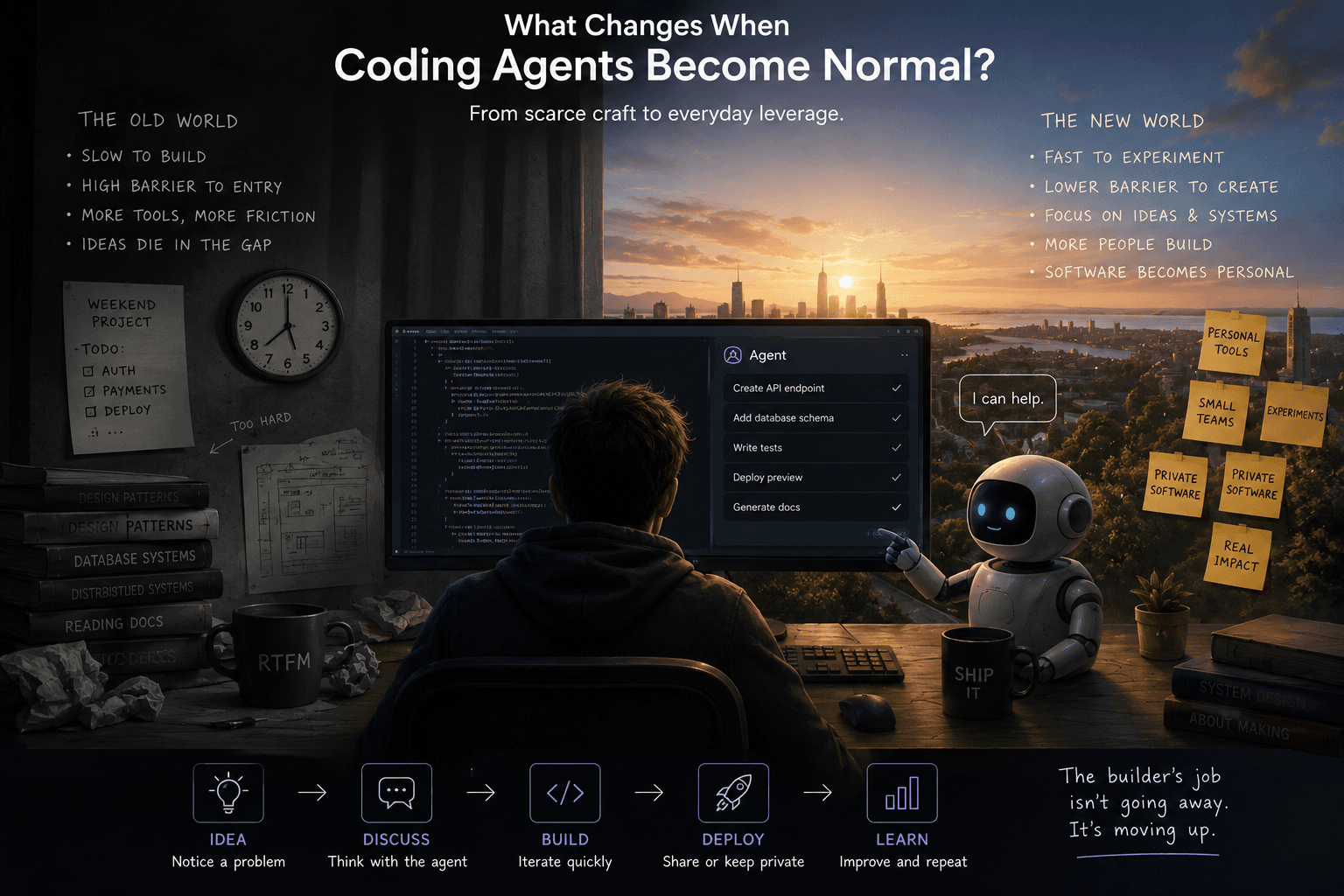
note
What Changes When Coding Agents Become Normal?
Coding agents do not just make software faster. They change who can build, how teams work, and what it means to own a system.
Coding agents are not just a better autocomplete. They change the shape of software work.
The obvious change is speed. A person can now move from idea to working prototype much faster. Small projects that used to require a weekend can become an afternoon. Boring setup work becomes less painful. Refactors feel less expensive. Documentation, tests, migrations, UI variants, deployment scripts — all the connective tissue around software becomes easier to produce.
But speed is not the most interesting part.
The bigger change is that software starts to feel less like a rare artifact and more like a material. Something you can reshape continuously. You can try things. Throw them away. Build tools for yourself. Make private software for one person, one family, one workflow, one weird habit. The economics of small software changes.
That matters because most useful software is not a giant product. It is a small interface between a person and a recurring problem.
A coding agent makes that kind of software more realistic. Not because it replaces taste or judgment, but because it reduces the distance between noticing a problem and making a tool for it.
The role of the builder changes too.
You spend less time typing every line and more time deciding what should exist, what should be removed, what is too complicated, what is unsafe, what is ugly, what is not worth building. The work moves upward: from implementation alone to direction, critique, systems thinking, and taste.
This also creates a new failure mode. It becomes very easy to generate too much. Too many features. Too many files. Too many abstractions. Too many half-finished systems. A coding agent can accelerate clarity, but it can also accelerate mess.
So the important skill is not only prompting. It is editing.
Knowing what to ask for is useful. Knowing what not to accept is more important.
The best use of coding agents may be as a personal workshop: a place where small tools, experiments, and private systems can be built without needing to become products. A website, a dashboard, a tracker, a messenger, a browser demo, a tiny admin panel. Things that are too specific for the market but valuable in real life.
That is the part that feels new.
Software can become more personal again.